homeschooldrama.com blog
How to Write a Play
We often learn from duplicating what we see and hear around us. When we learn to talk, we are simply mimicking the people who are talking around us. When we learn to draw, we first copy someone else’s drawing or something we see in nature before we come up with an original work of art on our own. In writing a playscript, it can be the same way.
Hi! My name is Danielle and I have enjoyed writing plays for my children and our homeschool friends and would love to share how to write a play, so you or your child can write one too.
When my kids first learned to write in elementary school, they would read other author’s works, then try to duplicate the style. Maybe they would write with a similar theme or take a piece of each work (learning to give credit where credit was due) and pull it together to make their own. Initially, they did not have enough experience to create something completely from scratch.
When telling a story, we know we have important elements to include in order to make that story flow well and come to a conclusion:
Characters
Setting
Plot
Conflict
Resolution
Throughout the years, as we read our children hundreds of books, they see these elements in the stories they hear and later read. They may not realize it, but as they start to tell their own stories, they automatically include these elements.
I remember when my kids were taking a writing class and the assignments started to require them to add more and more stylistic devices. At first, there were just a few, but after a while, every sentence in a paragraph was filled with them. My kids felt like it was too much to include all of those devices in one paragraph.
They were actually correct in their assessment, but what they didn’t realize is the point of the exercise was to get in such a habit of including those stylistic devices, that it became automatic for them to include them in their own writing. As they began to write more and more, they actually took less time in the editing process adding stylistic devices because they were already in their original draft. They also moved beyond three paragraph essays to multi-page essays, so they could spread the many devices between all of the paragraphs. 🤗
Another skill they learned when listening to all the books we read to them was to retell the stories in their own words or create their own based on similar themes. For instance, if they loved stories with knights and princesses, there would more than likely be sword fights and a damsel in distress in their stories. They might call their characters by different names, but the theme would be the same.
When first considering writing a playscript, it can be overwhelming to think up a completely original idea. Sometimes it’s easier to take a book that already exists and is well known and loved by all. You can use the dialogue and descriptions in the book to create your own script.
Keep it simple. If you enjoy writing and know the book well, you can express your creative energy and write a script that would work for your class and the time you have. I have enjoyed the opportunity to do that on several occasions throughout the years.
If you’ve noticed, a lot of scripts for plays and even movies are based on books that have previously been written. So why not do what the professionals are already doing?
As mentioned in my blog Write a Playscript from a Fairy Tale, the first thing you need to know is that you must either ensure that the book is no longer under copyright and therefore in the public domain, or you must get permission from the author of the book. Since there are a lot of popular books now in the public domain, it’s easier to go this route instead of having to get permission. Just be sure to check that it can be used freely to create derivative works like a playscript. If you go the permission route, just know that some authors prefer a professional playwright who has proven themselves to ensure their successful book also becomes a successful play.
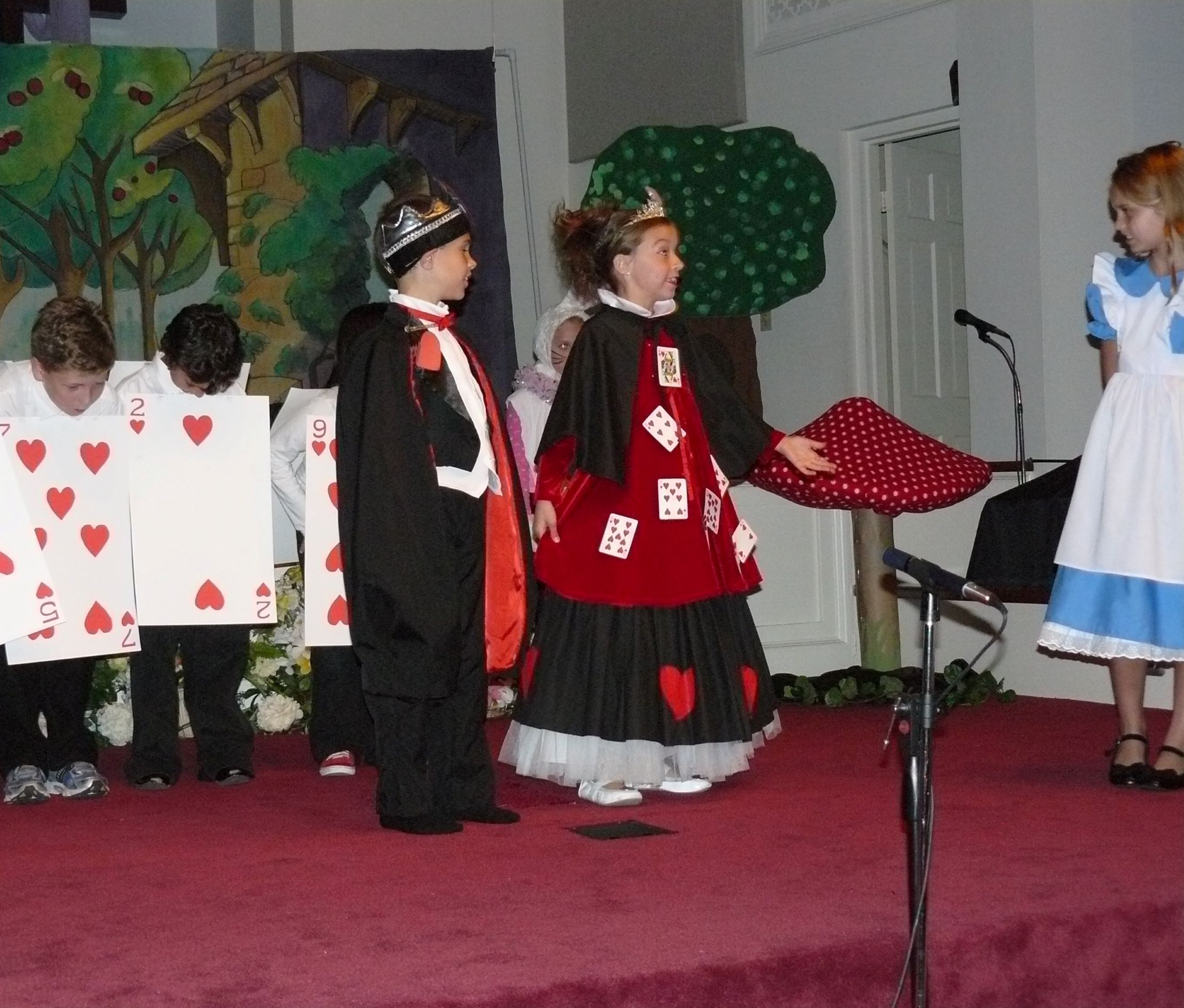
One book that is in the public domain is Alice’s Adventures in Wonderland by Lewis Carroll. His story is a favorite of mine for a playscript probably because I enjoyed performing in it when I was a kid. Also, I later directed a version of the play for my kids and the students from our co-op to perform in. You can find my play here!
Be sure to mention the original title and author of the book you are writing from. For example, you can say “based on Alice’s Adventures in Wonderland by Lewis Carroll.”
When you begin to write, you have to choose what parts you want to use, when the characters will speak, and if you’ll have a narrator speak to clarify what is happening in the scene. For my script, I chose to use Alice’s sister from the beginning of the story as the narrator. Since she is already reading a book, I chose to have her book be about Alice’s adventures. She just sits and reads out loud throughout the full play without being involved in the scenes except the very beginning and end with Alice.
Because I have performed Alice's Adventures in Wonderland before, I have my favorite scenes and characters that are a must to include. For example, the Mad Tea Party is so much fun and is a must for Alice as she travels throughout Wonderland. The White Rabbit starts the story off as he leads her down the rabbit hole into Wonderland, and the Cheshire Cat and the Caterpillar are interesting characters that offer her “wisdom” as she navigates the wacky world of Wonderland. For me, the croquet game with the Queen of Hearts and the flamingos is also a must. When the kids performed this scene, we used stuffed animal flamingos and hedgehogs or little balls with spikes on them. It was a lot of fun and looked just as challenging as if they used real animals. 🦩
There is a scene towards the beginning that comes from Chapter 3 – A Caucus-Race and a Long Tale. In this scene Alice has just cried so much that she finds herself swimming in her own tears (because she was so large and then shrunk back down again to a small animal size). She comes across a mouse and some birds and finds herself running in circles to dry off and offending many of them with her stories of her cat. There are a lot of details from this chapter that could be included, including the mouse’s long tale of historical figures, but I chose to leave that portion out and limit the story for time consideration and comic relief. The mouse is also a minor character in the book, so I didn’t want to take up a lot of time on his part.
If you are considering length, the rule of thumb is when a script is written in proper form - every page is a minute.
What is proper form, you may be asking? There are a lot of ideas on that topic, which can be determined by the person requesting the script or the region of the world in which you are writing it. One format is the “Standard American Format” which I have used as an example below from my play:

You will notice that the character’s name is all capitalized and centered on the page. The staging directions are indented, and the dialogue is aligned to the left. The font is Courier New with the font size of 12.
As you can see it’s easy to write a play if you start from something that is already created like a book. Using this method, you or your child can start writing a play today. Check out more blogs in the series, How to Write a Play.
Want to make life easier and be the first to know when the next blog is posted? Sign up below for our email newsletter to get the latest news!
Looking for a play to perform? Don’t worry we’ve got you covered with a variety of plays including The Big Race – A Montage of Aesop’s Fables and Alice’s Adventures in Wonderland 30-minute play!
Inspired by our blog series, check out our full How to Write a Playscript curriculum for more details to help you start writing a play today!
Thanks for joining us!
Danielle at homeschooldrama.com
Now you can have the full curriculum with 11 lessons to guide you from book to playscript!
This drama curriculum shows you how to write a play using Alice's Adventures in Wonderland by Lewis Carroll with practical examples, opportunities to practice, and additional resources to get you started.
6th grade - adults