homeschooldrama.com blog
How to Write a Play
When writing an original play of any genre, it’s helpful to start with a prompt or a theme. This blog will take you through the steps I took to write a mystery play, in hopes it’ll inspire you.
Hi! My name is Danielle, and I homeschooled my kids from preschool through high school. I have written plays for our homeschool community and want to share what I’ve learned and continue to learn with you.

My sister performs at a community theater, and she told me about a series they were planning to do in the spring. Playwrights can enter their plays for a chance to have them performed at this theater. They give the parameters of what they are looking for including theme and length and you submit your play hoping they will choose it.
I didn’t hear about it in time to submit it, but it did get my wheels turning while my family was together for a birthday. Sometimes one of us throws out an idea and we start to brainstorm off that idea. My sister and I are famous for it. Some of our best creations have come from a sudden brainstorm session. My sister originally wanted to write a play and had her own ideas. I encouraged her in her ideas, then started coming up with one I wanted to do. Others seemed to think it was a good idea, so I decided to sit down and start writing it once everyone was gone.
I thought it would be fun to do a play called, The Butler Did It!, based on the famous saying often used as a joke because the butler always seems to be blamed for the crime. Typically, in a whodunit you don’t know who committed the crime until the end. Here, you would know the butler did it, but wouldn’t know what happened. The goal was for the play to keep the audience guessing the entire time but with a twist.
I had a title, theme, and idea how long I was planning to make it. I started from the end and worked backwards as I came up with the storyline. I often do that when solving puzzles, so it made sense to apply it to a mystery.
When telling a story, we need to include important elements in order to make that story flow well and come to a logical conclusion:
Characters
Setting
Plot
Conflict
Resolution
I started with the setting and chose for it to be a mansion since there’s a butler. Then I considered who would be the characters that would interact with the butler. There needed to be owners of the mansion, so I chose a couple. I decided to keep the butler single since he lived at the mansion, and it worked for the storyline.
As you choose characters, you have to consider how they are related to each other:
Are they family? Co-workers? Neighbors? Friends?
How long have they known each other? What do they know about each other?
How old are they? How long have they been married or worked at their job?
What has happened in their past to lead them to this moment?
What are their characteristics? Are they hardworking or lazy? Are they empathetic or apathetic?
All of these questions help you create the dialogue and create depth with each character as they interact with each other in each scene.
As I talked through the plot of the story, it changed many times. What type of crime was happening, and how would it be discovered? What is the main conflict of the story that causes the events to unfold? I have found that it is helpful to just start typing and see what happens understanding that it is a work in progress and not the final draft. That philosophy has allowed me to get the ideas flowing, then continue in different directions finding the one I finally like.
Since it is a mystery, I had to think about what connections I needed to make. So, as I wrote the play, I would put different notes in the script for my reference to indicate how each clue was going to lead to the final conclusion. That’s why working backwards works so well because if you know where you are going, you can consider what you need to get there.
For example, if you’re going to have a murder, then you need a motive. You also need to know what led to the motive and the eventual crime. What connection does that character have with the murder victim? What clues led us to understand that this was going to happen or to look back and see how all the pieces came together? Did we give the audience enough information to follow along with the story?
What is the main conflict that leads the criminal to commit the crime? Was he desperate for money and chose to rob a bank? Did she have a series of events occur that led her to spiral in a bad direction? Was there a misunderstanding that led him to the wrong conclusion and therefore a bad decision? What about greed or jealousy? Was it premeditated or did it happen in the heat of an argument?
The resolution is the outcome of the conflict or the end of the story. How did the character resolve the conflict he was having? Did he choose to forgive, leave town, or worse - commit murder? How were other characters affected by this crime?
While writing my play, I first ended it one way, then chose to change it. I just wasn’t happy with how my characters handled the situation and decided to go in another direction. That’s the beauty of writing an original play. Later I decided to create a full-length version with an alternate ending so the actors could have a choice which ending they wanted to perform or choose a different ending for a different night.
If you are considering length, the rule of thumb is when a script is written in proper form - every page is a minute.
What is proper form, you may be asking? There are a lot of ideas on that topic, which can be determined by the person requesting the script or the region of the world in which you are writing it. One format is the “Standard American Format.”
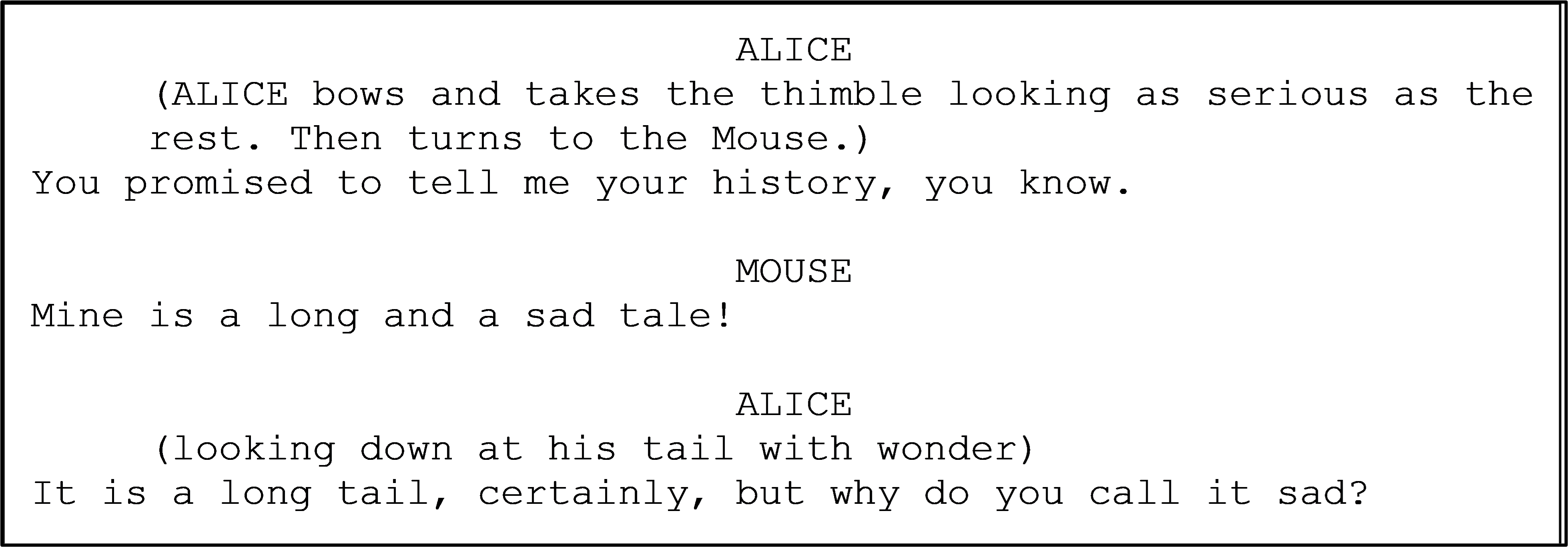
With this format, the character’s NAME is all capitalized and centered on the page. The staging directions are indented and in parentheses, and the dialogue is aligned to the left. The font is Courier New with a font size of 12.
Here's an example from Alice's Adventures in Wonderland 30-minute play:
Here’s a summary of the finished play The Butler Did It! as an example:
In this one-act play, keep your audience on their toes with this twist on a whodunit.
Hunter and James are brothers living in the mansion their father left them. Hunter took over the family business, while James serves as the butler. James starts asking a lot of questions when he discovers something while his older brother and attorney plan a cocktail party for a special guest.
The secret is out. How will the butler respond?
Now that you’ve written it, it’s time to direct, perform or submit your original play for someone else to perform. Don’t just let it sit there on your computer or on a piece of paper, take it to the next level by watching it come to life in a performance.
Want to start writing something but don't feel you have an original idea? Check out How to Write a Playscript drama curriculum to start with something you may already know like Alice's Adventures in Wonderland, a fairy tale, or Shakespeare.
Don’t want to wait to write a play? Check out these plays, including The Butler Did It! to get started today!
Want to make life easier and be the first to know when the next blog is posted? Sign up below for our email newsletter to get the latest news.
Thanks for joining us!
Danielle at homeschooldrama.com
In this original one-act play, keep your audience on their toes with this twist on a whodunit.
Hunter and James are brothers living in the mansion their father left them. Hunter took over the family business, while James serves as the butler. James starts asking a lot of questions when he discovers something while his older brother and attorney plan a cocktail party for a special guest.
The secret is out. How will the butler respond?
Enjoy more character development, comedy and mystery in the full-length version of this original twist on a whodunnit.
The sudden death of their father leaves Hunter and James to figure out what to do with the family business. After the reading of the will, Hunter is left in charge of the business while James runs the mansion as the butler. James starts asking a lot of questions when things just aren't adding up. The secret is out! How will the butler respond?
*now with option for an alternate ending