homeschooldrama.com blog
How to Fit Drama into Your Homeschool
Why is it that drama is always pushed to the side for other “more important” subjects? Yes, we all know we must check off certain boxes, but that doesn’t mean we have to leave drama out of our homeschool.
After 20 years of homeschooling and 15 of them with the classical model, I have learned well how to integrate subjects to focus on the skills students need to learn and not just the box that has to be checked.
In a previous blog I focused on the 7 Skills Your Student Can Learn by Including Drama in Your Homeschool, so you can read that to see WHY I think drama is important. Here I want to focus on HOW to fit drama into your homeschool without leaving those all important subjects behind.
The easiest subject to integrate is probably literature. If you are in high school, you can easily take a year of British literature or Shakespeare and read through some of Shakespeare’s plays. However, you don’t have to stop there. Just reading them may not be what you had in mind for a fun drama class.
You can:
Try to write your own play using his style. (Check out our How to Write a Play blog series and drama curriculum)
You can act out some lines in the play as a solo interpretation, or have someone join you for a duo. Add some basic costumes and some props and you have a short skit.
You can act out a shorter version of the play. Here's an abridged version of the famous Shakespeare play - Macbeth 30-minute play!
Why not take it a step further and put together a case against Macbeth for the murder of King Duncan with Macbeth - The Mock Trial.
One year as part of our homeschool group that met once a week, we were reading Shakespeare’s Macbeth, and one of my students asked if the class could act out scenes together instead of just doing a solo or duo interpretation. I said, “yes!” of course, given my love of drama. I provided a short script and assigned roles so they could get started.
Since they were juniors in high school, I gave them full responsibility for making decisions on directing, costumes and props. Now we only met once a week and this couldn’t take over their other subjects, so we had to keep it simple. We were blessed to have watched Macbeth at our local Shakespeare theater and were able to glean some ideas from them since they worked on a small stage with limited actors. They literally changed costumes right in front of our very eyes, and we were able to see them as the new character without ever thinking of the old. No more complicated costumes or scene changes for us to worry about.
We were able to stay within the parameters of the normal time we would study this play and performed in front of the rest of our homeschool group in the fellowship hall of the church. They did a wonderful job of memorizing their lines, getting into character, and performing an incredible fight scene between Macbeth and Macduff.
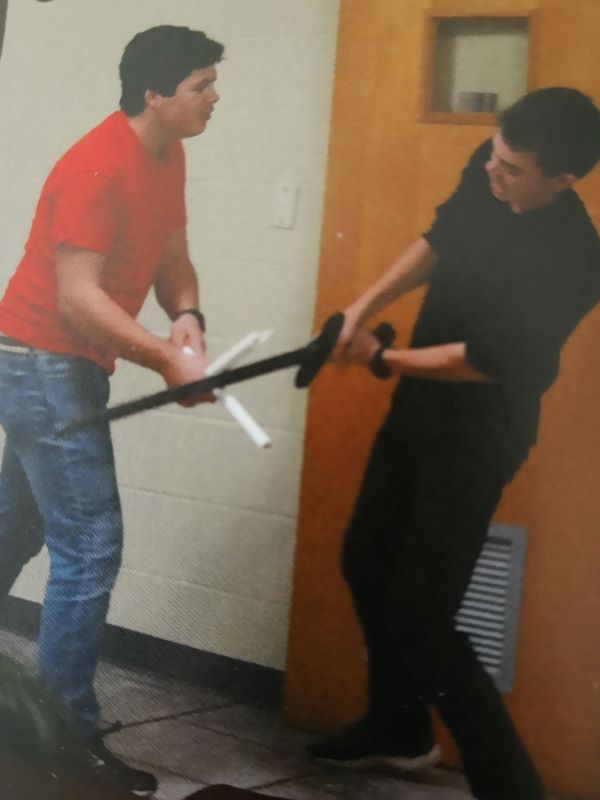
Funny story, actually, related to the sword fight. I learned a good lesson in checking props before allowing the play to begin. If you notice in the picture above the PVC pipe sword is quite short. Well... the boys decided to use a stronger more real looking sword for Macbeth, instead of the one they had been practicing with. It actually chopped part of the PVC pipe sword off and it went flying across the room. Thankfully it didn't hit anyone, but wow it was a powerful blow.
Another good lesson that was learned was when one student wanted Lady Macbeth but didn’t get the role and was left with three minor roles throughout the play. At first, she thought they weren’t important and didn’t like the idea of having to be them, but then she embraced them and had a lot of fun with the parts. The once insignificant nobleman and messenger became a hilarious and memorable addition to the scenes she was in. Lots of great lessons are learned in drama.
The Macbeth play has become a tradition with the junior class each year. It has been fun to see how differently the same play can look with different people playing the roles.
Now Shakespeare is an obvious choice to include drama, but you can use any literature book to accomplish the same goal. Some have already been made into plays, while others can be created into a play with some imagination from the class. Choose a favorite scene in the literature book you are reading this year and have fun making that book come to life.
Keep it simple. If you enjoy writing and know the book well, you can express your creative energy and write a script that would work for your class and the time you have (just be sure it is in the public domain and no longer under copyright - Project Gutenberg is a good source). You can also check out our blog series How to Write a Play for multiple ideas.
I have enjoyed the opportunity to write a play on several occasions throughout the years. You can read this blog to learn more about one of the first plays I wrote based on Aesop's fables. Other times, I didn’t have time to write anything, or was not as familiar with the story, so finding something that was already created was the way to go. You can check out the plays we've done here.
Or, as mentioned before, you can simply choose a favorite scene, or have small groups of students choose their own favorite scenes and create a performance from it. Your students will learn more about the book and remember it better because they took the time to get into character, consider what each person was saying and how they should act in that situation. Great discussions about the book can come from these decisions to act out a scene in a particular way. You will also know if they are fully comprehending the text and its theme.
You do have the time to fit drama into your homeschool by integrating drama into the subjects you are already studying like literature and Shakespeare. It doesn’t have to take a lot of extra time and can enhance your studies. Plus, it is always fun to see kids take on roles and make the story their own.
Looking for ideas for younger students, you can read Add Drama for the Younger Siblings, or check out the various plays we have based on great literature here like Winnie-the-Pooh and Alice's Adventures in Wonderland.
Want to make life easier and be the first to know when the next blog is posted? Sign up below for our email newsletter to get the latest news!
Thanks for joining us!
Danielle at homeschooldrama.com